Tuesday, September 30, 2008

A Brief Qual and Quant Overview of Today's Hot Vids!

Fact: I began this post not knowing exactly what my topic would be. The enormity of online media can be paralyzing. As the online space expands like a supernova in every natural aesthetic, organizational and ideological direction, one of the most complex and fascinating core problems remains the issue of how to filter, silo and interlink the literally endless amount of content. How to know what's really going on online? How much of this stupid shit/cat photos--to paraphrase Rimma--really matters? Perhaps he mother of all video channels, the third-highest trafficked site on the web, YouTube, can serve as some sort of barometer. Here's a screen shot of the most-viewed videos as of Sept. 28:


It's kind of hard to make out, but as of this date, the first five videos were Sarah Palin-related: replays, parodies or reactions to her Katie Couric interview. The top 20 videos, categorized first by content and then by source, are as follows:

Sports clips: 5
Political or Political Mash-ups: 4
Sarah Palin: 9
Personalities*: 2
____________________

User-Generated or Edited: 5
Pulled from Broadcast television: 15

This rough breakdown indicates that Youtube may serve popularly--predominantly--as a distillation of what appears on broadcast television, like a greatest hits reel. User-generated videos, on the other hand, can come in the form of either pure busts of individual self-expression (vlogs), interpretive mash-ups of outside content (often political messaging), or some combination thereof. To roughly paraphrase Marx, the means of production is now hypothetically in the hands of the people; the platform is potentially rendered egalitarian. The extent to which this is true is a whole 'nother debate--seriously undermined, of course, by the gaping digital divide and by the misguided lionization of the amateur, Andrew Keen would argue. I'd love to hear more of Lawrence Lessig's (usually optimistic) thoughts on the potential of the online space, as well as those of the self-described "leading internet critic" Keen.

But back to User-Generated Content. UCG comes in many forms, of course: political messaging mash-ups, silly remixes that take a newly birthed catchphrase (e.g. You Base Are Belong to Us, The Whistle Tip courtesy of our very own KRON, the "I like Turtles" kid and its remixes), mashups with no particular satirical target or an apolitical target.

There is also the phenomenon of YouTube stars, defined as those individuals who have used YouTube exclusively as a launch pad towards notoriety. Of those personalities, one is a familiar face first launched to YouTube stardom with a widely viewed video of herself hysterically imploring the public to Leave Britney ALOOONE!!!!! following her disastrous 2007 VMA performance. Crissy Crocker, the world's most infamous Britneyphile, is still on top, so she claims in her latest vlog, entitiled "I am YouTube."


The self-professed Most Popular Person on YouTube--which she questionably claims couldn't exist without her--Chris addresses charges that she's changed as a result of her fame. Advertisements for her new single (who knew?) litter the backdrop of her channel page. For all her grandiose claims of existensial solidarity with one of the web's most powerful platforms, Chris is right about one thing: She remains the most popular single YouTube personality if current "most watched" tracking is to be believed. By YouTube personality, of course, I am referring to those who built their fame by gazing existentially into their webcams and letting loose whatever outrageous chaos roils inside their minds. Through the inscrutable, practically unknowable process of meme pollination that Rimma expounds upon in her post, Crocker and a few others (Tay Zonday, Tina, Tricia "Crazy Eyes" Walsh-Smith) have become legitimate celebrities in their own rLinkight. Crocker and Walsh-Smith's channels have thus become hotbeds for advertising content.

What about these people in particular led to their popularity? At some point, they are deemed worthy of scrutiny in the blogosphere and sometimes, eventually, in the "traditional" press. Tina, for instance, the delusional teen girl who sings Backstreet Boys into her webcam, was first noticed and snarkily commented upon by Perez Hilton, whose blog is among the most popular in the world.

But why these individuals in particular, and what does it all mean? The long and short answer is that they get attention because, obviously, the poor things are all nuts, and seemingly (with the possible exception of ultimate YouTube Mean Girl Crocker) unaware of that perception. But by the same token, they are--as far as we know at least--authentic in their outrageousness. Yes, they really are genuinely nuts, and thereby compelling to watch.

As Rimma points out, and as I have alluded to in previous posts, this is the sense of authenticity that marketers are desperately trying to appropriate and mimic. LonelyGirl turned out to be a fraud. But what is the next step in the effort to close the gap between authentic experience and the image of life that advertising contrives and attempts to proliferate? Now that voice, agency and thereby power, so claims Crissy Crocker herself, is in the hands of "the people"--that is the consumers, the End-User rather than developer--advertising therefore must accept and pander to the individual empowerment and resistance to authority (advertising, copyright laws, for instance) that this all yields. So how can brands most effectively insert themselves into this process of identity-building and impression management that occurs online--of which Crissy Crocker perhaps stands as a high-profile, if extreme, case study?

Will individuals even more brazenly offer themselves up for branding? My Life and Personhood sponsored by Marshall's, Doritos, Kia?

If the right brand were to make you an offer, would you accept it?

Americanization of the popular Television Shows in China

When observing most popular Chinese TV shows, people will easily notice that these shows all “borrow” the format of some of the popular American TV shows. For example, “American Idol” is so worldwide popular that many other countries such as China, Australia, New Zealand, Spain and Sweden are producing similar kind of TV programs. China broadcasted a TV show called “Super Girl” (or “Super Girl Voice”) in the past years, which had similar format of “American Idol” with different rules. All of these TV shows have been very popular and had great impacts on various aspects of the societies during all these years. The format of the show is turning to a worldwide media trend, which seems like a guarantee of high ratings, satisfied commercial outcome, becoming famous rapidly (for the contestants or the judges), and success in TV industry. Suddenly, many countries from different cultures were linked by an invisible internal connection called “Pop Idol Culture” and were sharing this common “culture”. This “culture” is becoming an international issue.
“Dancing with the Stars” is another popular TV show, which the format was also borrowed by a Chinese TV dancing contest called “Dancing Together”. This program shared exactly the same format of “Dancing with the Stars”: they invite celebrities to compete their skills in different types of Latin dance. In addition, there are some intelligence and knowledge challenge shows (such as “Happy Dictionary” and “Lucky 52”) and situation comedies (like “I Love My Family” and “My Own Swordsman”) are very popular in China in recent years, which borrowed the format of “Who Wants to be a Millionaire” and “How I Met Your Mother” respectively.
The “pop idol culture”, the dancing show, situation comedy, and intelligence and knowledge challenge show turn out to be the representations of “media globalization”. Because the origins of these shows were all from the United States, I would call the phenomena of applying American TV show format into Chinese TV shows as “Americanization of Chinese TV show”.

1. Relationship between media globalization and technology
Development of technology is the base of media globalization. The success of the competition shows based on the development of both traditional media and modern media. Traditional media refers to television, which not only provides a platform for TV program, but also earns great profits through rating and the commercials. New media refers to the internet and mobile phone. The internet helps the TV program to get lots of attention and reputation, which plays significant role in promoting the program. In addition to the internet and television, text message is an essential form of media in the whole program. It brought the organizers, sponsors and telecommunication companies enormous profits through sending and receiving text messages. For “Super Girl” case, voting through text message is a new form of involving the audience to the TV program, it gave people not only a chance of free choice but also a sense of cultural democracy, mobile interactivity in ‘Super Girl’ has given the Chinese population a new mouthpiece – and one that it is very hard for the government (who have even managed to censor the Internet) control.

2. Manipulation of art activities in the age of globalization:
Media Americanization is well presented in the “Americanized” shows through the similarities that the shows have been manipulated. The existence of “pop idol” helps with making profit for the creators and developing TV and pop music industry. Both American idol and Super Girl have got great success because of the common ways they manipulate the show: the songs that contestants selected were all very famous or classic, which help the audience have a better perception of American / Chinese pop music; The judges are all famous music professionals and their comments are humorous and unpredictable; easy access of the competition; great audience involvement. The winner was selected by audience’s voting, which makes audience feel like being respected and involved, and so their passion for the show is motivated.
There are similar functions of both of “Dancing with the Star” and “Dancing Together”: some popular stars present the other side of them to the audience through this program, and some other unpopular celebrities join the competition to keep more exposure to the public.

3. China’s reactions towards media Americanization:
Although there are lots of similarities between these American and Chinese TV shows, China still have different applications about this “Americanized culture” because of different culture, social or political policy. “Super Girl”, for example, only women were allowed to apply for the competition. The reason for this is that unlike women in western cultures, Chinese women have been educated with conservative traditions which do not encourage them to freely express and present themselves. Therefore, the existence of “Super Girl” became the representation of rebel of Chinese traditional value and provides a stage specifically for Chinese girls to present themselves. That is why Li Yuchun, who is not as charming as the meaning in Chinese traditional concept, won the first prize in the competition in 2005.
In situation comedy like “How I met your mother”, there are lots of scenes with talks about sex and romantic relationships. However, in Chinese situation comedies, sex talk will never be allowed to appear on the small screen. Instead, the stories more concentrate on friendship and the relationship between family members, co-workers, etc.
Comparing with the American style, more “gambling”-like game in “Who Wants to be a Millionaire”, Chinese “Happy Dictionary” and “Lucky 52” are less money-motivated and more about “making dreams come true”, because in Chinese culture and values, we do not encourage people to be too utilitarian or material.
Despite the traditional culture, further government control and arrangement of “Super Girl” is also different with “American Idol” because of different political policies. The (Chinese) State Administration of Radio, Film and Television issued new rules to regulate Idol-inspired shows. The rule pointed out that the contests should contribute to "constructing a harmonious socialist society”, which means the program should be positive and healthy. This action revealed that “Super Girl” may bring problems to Chinese society: because of the text message voting, somebody considers “Super Girl” as a force for democracy. For a country like China which is lack of democratic choice, this opportunity to vote would make a huge difference in people’s mind and inspire Chinese intellectuals to imagine about arrangement for democratic elections and awake people’s democratic consciousness in the younger generation. Some people were worried that voting for TV contestants would make Chinese want to vote in other contexts, such as for their political leaders.

The application of popular American TV show into Chinese TV program becomes a representation of “media Americanization”. However, although “pop idol”, situation comedy and knowledge challenge show are mass-produced in China, it does not mean that Chinese TV programs are totally Americanized. While borrowing the popular form of American TV program, Chinese TV station make the American culture localized, so that the program maintained the features of Chinese nation. Besides, because of the different culture and social policies, Chinese TV programs which have similar formats with American ones may have different content and treatment.

A few things off my chest

I'm not sure what to write about, so many things are troubling these days, but there are some things that have been bothering me for quite a while and seem perpetually timely; so I thought I might as well use this opportunity to get them off my chest.
I'm bothered by cultural amnesia and that I am old enough to watch history repeat itself. It's not the getting old that is upsetting - well, it is tiresome, to be honest - it's the realization that we as a people do not learn from our past mistakes nor heed the warnings of those we claim to esteem the highest.

I believe that through the Internet, more accessible and democratic media paradigms are emerging that will ultimately replace the present corporate controlled model; however, I fear that this might further exacerbate the schisms that already divide our culture. While the current trend of community building is a positive development in the use of the Internet, the technology actually discourages communal use and experience. Much like the automobile's effect on transportation, the Internet physically isolates the individual and precludes a shared journey. Instead, the Internet user can avoid new experiences and chance encounters by sticking to the same path and associating only with communities of similar belief or worldview.

I'm wary of a future where each individual can create a virtual world in which all assumptions go unchallenged, all associations reaffirm, where one can indulge in conformity and revel with only the like minded. As we progress towards digital convergence, personal communication and media become increasingly entangled; if, as James Carey defines it, communication is the symbolic process by which we produce, maintain, repair and transform reality, what kind of future are we looking at? Even more of what we already have.

I remember thinking back in 1984 that I saw nothing of Orwell's vision of a future dystopia; in recent years I have seen it increasingly manifest in our culture. What happened between then and now was the implementation of the neo-con political economic vision championed by Reagan and carried out by those following who canonized him as the patron saint of the conservative. What Gitlin describes as the "cultivation of surface" and the "stylized blankness" that emerged during the Reagan years seems to have evolved into an Orwellian disconnect between surface and substance, where words (compassionate conservative) can appear on the surface to mean one thing while actually signifying the opposite in meaning and where identity (Christian Right) can become the opposite of its defining characteristics when co opted for political power.

We are currently in the midst of an economic crisis; what some say is the result of the full realization of the neo-con economic policy. If this is true, can the cultural fallout be far behind?

Peace

Brand New Jokes, Same Old Theories

The creation of the modern “easy” video distribution model has led to many “unrestricted” viral sketch comedy videos hitting the Internet. I would attempt to argue that modern viral videos apply elements of centuries-old theories to create comedic moments, elements which have been applied to a lesser-degree in mainstream media for decades. Naturally, many have argued that dissecting humor immediate removes the comedic value, thus rendering any advanced analysis fruitless. Towards these valid, but open-ended arguments, I wish to submit the following rebuttal: It’s flipping easy, and I’ve got the cashed checks to prove it. By using the applied studies of theorists such as Marx, Freud, and others, formulae for creating comedic moments can be made, and can be applied to create new humorous sketches.

The old joke of portraying figureheads behaving in farcical manners, can be viewed as more than just silly. When a public figure is portrayed as both nutty and abusive of power, they are illustrating the extreme ends to which the bourgeois can oppress the commoners. Marx passionately argued against this type of power abuse, and furthermore argued that it can be manifested in many types of governments. The above short illustrates the hidden power of the ruling class in democracy. Notice the strong Marxist symbolism when John Wilkes Booth finally “rises up” and defeats the ruling class with a hammer.

While the discredited volumes of Freud are veritably mountainous, there’s comedy gold in them thar’ hills. In fact, the Freudian defense mechanism of repression, particularly hetero- and homosexual repression, is almost always sound fodder for a comedic premise. The simple manifestation of unconscious desire, or a verbal spillage of the unconscious can almost always bring laughs if delivered correctly. In addition, the general acceptance of applied psychology, which Freud helped pioneer, has led to many skits and scenes with the main premise of psychological testing.

It’s not just these founding theorists who can be used to create humor. Most modern theories, if stark and depressing enough, can be twisted to create a comedic flow. The speculations on the extreme drive of business-driven greed, most notably by Todd Gitlin, has been parodied in modern media for decades. In fact, this notion is often spoofed by the media itself, such as in this classic sketch where the talk show host feels only for ratings. In fact, simply having outlandish characters ignore human perils and common convention in search of profit is frequently the fodder for popular viral sketch videos.

Though comedic presentation is an art form, by juxtaposing exaggerated theories of power and repression with modern inconveniences, a practically timeless formula for humor creation is revealed. Naturally, a bit of joke writing is needed, but these applications have been proven for decades of broadcast sketch comedy. With the introduction of the home video studio revolution, it is possible to distribute even more stark exaggerations and examinations of modern life, without the sharp restrictions of the broadcast regulatory agencies. This could lead to a revolution in more than just video distribution, perhaps the very limit in our ability to be self-expressive and comment socially is loosening.

Drink it my friend

Advertisement sector in Turkey has been operating for a very long time. However, it is hard to say that most of the commercials and advertising campaigns are made very professionally until 2000s. In 2003 a new soda brand Cola Turka, which sells cola soda, entered the market. Their advertising camping was very professional and successful. The brand name became known immediately.

I believe that developing countries are still learning how to become more professional. It is a hard and time consuming process. Cola Turka's campaign is a good example of using financial and creative sources effectively from the perspective of acting as a professional in the market.

Two TV commercial videos below were first aired in 2003. Commercials show that Americans are becoming Turkish after they drink Cola Turka. The main purpose is to impose the idea of nationalistic branding at first. Commercials basically try to impose the idea that even Americans - the creator of cola- drink Turkish cola. Whenever an American in the commercials drink it, they start saying Turkish words and doing Turkish oriented expressions. Just in the beginning, we see African American people screaming "sampiyon Turkiye" on a truck which means Turkey is the champion. It is related to the most popular sport "Futbol" (Soccer) in Turkey. I should inform you that whenever there is a victory in an international soccer tournament, Turkish fans go out celebrate like crazy with other fans on the streets. Later on we see Chevy Chase meets with a guy in a bar who has a cowboy hat. They start talking and the guy who has a cowboy hat says Turkish words, and drinks Turkish cola. He asks Chase how is "Yenge" doing which means how is his wife doing. That is such a Turkish word and an excerpt from lifestyle. Yenge is literally means sister in law, however in Turkish culture especially close friends use the word yenge in a way as in the commercial. Rest of the commercial and the next commercial are also about how Americans that drink Cola Turka becoming Turkish. We even see Chase's new mustache after he drinks too. The way commercial mocks both culture is very smart. It both creates attention and delivers the message.

FIRST COMMERCIAL
... alternative link
SECOND COMMERCIAL ... alternative link


I remember how people were in rush to buy Cola Turka after these commercials were aired. People from any class, age, sex wanted to taste the new cola in the market. I remember myself buying it in the first week of its release. Well, to be honest, I did not like it and have not drink that since. On the other hand, it is the second biggest brand after Coke Cola in cola market in Turkey now. Pepsi lost its place to Cola Turka in a very short amount of time. Successful brand marketing is always sells and companies from developing countries should not feel insecure. They should focus on creative messages and productions. Thanks to the Internet, today, there are more opportunities and ways to deliver a message, show a product.

Athletes and Advertising, SCORE!

Professional athletes are held in high regard amongst sports fans. You don't even have to be sports fan to understand who these players are. For example, some people may have never seen a professional basketball game, but they know who Michael Jordan is. Some may have never played or watched golf, but they know who Tiger Woods is. The reason being, is that that these two athletes are all over the advertising world. This shows the possibility that using athletes for advertising is working. The point is that most viewers are captivated by these athletes. Advertisers are clued in to this, and have figured out creative ways to use athletes to sell their products.

I'd like to look at the way in which professional athletes are being used to help persuade consumers to purchase certain products. Throughout the post are examples of Gitlin's idea that media/advertising/images help the viewer slip away from the 'encumbrances of society', providing the viewer with a look into the life of an athlete. Advertisements portray athletes as everyday individuals, off their playing field, while showcasing their celebrity status in an obvious commercial way. In so doing, the advertisement leads the viewer to believe that what that product does for their favorite athlete, would be good for them as well. Looking at some examples that use humor, I will show how this process truly does provide an alternative look at the mainstream form of advertising: 'here's the product, now buy it' mentality, while reinforcing the hegemonic idea of capitalist America.

While using professional athletes is the most ideal, sometimes writers stray from this concept, and invoke a parody of an athlete. This particular character may not truly be an athlete, but has no problem playing one. The form stays true however, in depicting an athlete in a comedic way to sell, in this case, Bud Light.

Sometimes the comedy is light, but it doesn't mean that some media writers won't paradoy it, and take it to the next level.

Gitlin would not be proud of some of the commercials of today. They remove the viewer from themselves, and fall into the world of what they are watching. Some organizations are getting very good at the way they put their commercials together. One that comes to mind is ESPN, that promotes their show Sportscenter. They give you a behind-the-scenes look at the life of the sportscaster, no matter how comedic it may be. There was a particular commercial that was able to accomplish two motives: one to publicize the show in a humorous way, and the other, perhaps even more of a marketing form of genius, a subtle plug to drink Vitamin Water (new at the time).

It is these subtle ways that reinforce the hegemonic goals of advertisers in television. Sometimes, they even play for personal gain to these professional athletes.

It's important to note what types of commercials I'm not referring to. They aren't direct. They don't usually say watch me, or buy me. However, I should acknowledge that this direct marketing can work, and a lot of athletes are seen in this type of marketing.

Sometimes the commercials don't even have to be funny. All they need to do is captivate the viewer.

The point is, these commercials allow viewers to simply feel the role of these professional athletes. They lighten the mood from life in general. The moment we are removed from this state of consciousness of 'I am being sold something', to 'man, this is pretty funny', is the exact moment when the hegemonic ideals concerning the hierarchal power of marketing executives are implemented into our train of thought to remember their products. Sometimes they don't even have to be funny, sometimes than can just plain make you feel good.

This stuff makes them crazy

Government, glory be its name, claims the monopoly on both violence and the rules that govern our lives. So-called illicit “drugs” present hegemony-minded government with two challenges: dealing with perceived problem groups and maintaining a predictable and obedient public mindset. And who can think of a more disruptive bunch of garden party-crashing, pee-on-your-bonfire types than the marijuana-smoking cabal?

Marijuana prohibition began as an outlet of anti-Mexican-American sentiment, beginning in Utah in 1910 and quickly spreading across the country. One Texan senator said, “All Mexicans are crazy, and this stuff is what makes them crazy.”

In Eastern US states, fear of blacks drove marijuana prohibition as the drug traveled from New Orleans to Chicago to Harlem and became part of the music of Cab Calloway, Louis Armstrong, and others. An editorial in a newspaper in 1934 ran, “marihuana influences Negroes to look at white people in the eye, step on white men's shadows and look at a white woman twice.”

But racially-motivated prohibition didn't stop marijuana's spread. In the 1930s, the racial story was dropped in favor of the violent behavior rationale and the government's attention began to focus on general public obedience.

However, a few decades later, the 60s happened and pot was everywhere. The government tried to propagandize against the flow, but look who they were up against.

When hegemonies can't beat down a threat, they often try to neutralize it, absorbing part of it into public culture (this is not necessarily a conscious process). It took 1978 to finally make it happen to pot on the silver screen, when the leaf was cast as a fun diversion for (lovable, I guess) losers.

Following successful institutional efforts dominant powers usually rely on continued and spontaneous consent by the public. With marijuana widely accepted by much of the public as undesirable, the drug (and drugs in general) has become interwoven with other government hegemonic messages, be they post-9/11 terrorist fears, use of superhero role models, fear of disapproval from one's dog, or, most infamously, danger of overcooking eggs.

However, neutralization through absorption might mean eventual victory for the rebels. If the role models in this newest absorption device are the current faces of pot, is marijuana legalization so far away?

Monday, September 29, 2008

20 years of American pop culture in China

In the early 1980’s, television started to enter the average family's household. At the time, Chinese-made TV shows were very popular. The first big event, the 1983 spring festival gala, was a milestone that represented a new era of television in China. Despite the popularity and strong desire for Chinese-made programs, American pop-culture made its imprint on Chinese culture. I will introduce to you a few items that were signs of this throughout years.


Breakin (1984)

Only a few foreign programs and movies were imported to china during this early period. With a movie called Breakin, break dancing became extremely popular among young people. With only a "boombox", they would dance anywhere in the city, challenging the traditional Chinese way of dancing. Break dancing mocked the traditional way of dancing. And American pop culture, for the first time, entered public attentions. This is not merely a new entertainment for the public, Breakin presented the American culture to the nation, a different ideology which people can compare with their owns.


Small wonder (1985-1989)

This is certainly a comedy. It was broadcast on CCTV in the early 1990’s. Small wonder (translated to Chinese as “Robot girl”) is about an engineer who has secretly built V.I.C.I (Voice Input Child Identicant). The storylines involve the family from keeping the secret of their "daughter" from the neighbors. Because traditional Chinese folklore is more historical and less involved in science and technologies, Small wonder was a big success. Many people today still can remember watching this as a child.


A native of Beijing in New York (1993)

This is a story about a Chinese couple that immigrates to New York, chasing the “American dream”. Struggling with culture differences, divorce and remarriage, the characters reflect the true posture of the immigrants from China during that time. “If you love him bring him to New York, for it’s heaven. If you hate him, bring him to New York, for it’s hell.” was a classic line that became popular with the Chinese.

Titanic (1997)

This movie didn't make it to theatres until 1998 in China. This big-budget Hollywood movie had no problem attracting Chinese audiences. The novel, music cassettes and posters were sold out frequently. The sound track from the movie was as popular as Chinese pop music, and Celine Dion was well known from then on. "Titanic" is even used as a fashion word, describing a hopeless or desperate situation.


American Idol (2002- now) VS Super Girls (2004-2006)

Many young Chinese watched foreign shows online. American idol became incredibly trendy show to watch among young adults, even though it was not broadcast on any Chinese television station. Kelly Clarkson and Justin Guarini are well-known. Until 2004, a local Chinese TV station held a similar version of “American Idol” which translated as “super girls”.


Human is in the center of society, who manipulates the nature of history. “Culture is an organization, discipline of one’s inner self,” Gramsci indicated. If a single piece of opinion is gradually accepted by the public, then it quickly forms culture. Gramsci saw the huge power that culture brings along, and therefore he believes in the revolution of changing the society by means of ideology.

Equality and stupidity for everyone.


Wikipedia, that bastion of accuracy, defines an internet meme as: a neologism used to describe a catchphrase or concept that spreads quickly from person to person via the Internet. The term is a reference to the concept of memes, although this concept refers to a much broader category of cultural information.

And sure enough, funny things (hereafter referred to as lulz) on the internet have been disseminated through word of mouth, or rather, word of e-mail since such a thing became possible. I remember my first e-mail account in 1993 being filled up with forwards of primitive lulz from my dad, an internet veteran even then - he was probably the only other person I knew with an e-mail address. Often times, these lulz are inexplicably funny. They’re sometimes witty and clever but frequently nonsensical and absurd. Something about them compels viewers to share with their friends and as a result, our inboxes are stuffed with genuine humor and countless imitators that fall flat. Videos, images, comics, essays - nowadays, everyone is trying to be funny.

Does anyone remember All Your Base? This was a phenomenon of lulz dating back to 2001; almost primitive compared to some of the things circulating nowadays. It began innocently enough - a poorly translated video game from Japan (as shown in the first few seconds) generated a catch phrase (All your base are belong to us) that was absurdly funny. A clever few Photoshopped the phrase into unexpected situations and the 'net was soon flooded with imitators, spawning hundreds or even thousands of All Your Base lulz. A band composed a catchy song and someone took the best of the Photoshops (or Photochops as they are frequently called) and the song and strung together this video that spread even faster than the original meme. Watch it here:


There's no way to explain why this is funny - it was certainly the funniest thing anyone had seen in a long time during its heyday. Numerous other lulz have been shot around to varying successes, even creating some minor internet celebrities along the way. Do we not remember Numa Numa guy? Star Wars kid? Tay Zonday? Or maybe it's just me.

Marketing firms have attempted to capitalize on this phenomenon, creating viral marketing videos that they hope will catch on and spread like genuine memes have been known to do. True memes are funny spontaneously; for every video and image that gets passed around, there are hundreds that are forgotten because they lack the je ne sais quoi that sends something around in the first place. Nonetheless, the internet is seeded with fake videos created by corporate megaliths, all trying to find the formula for why this sort of thing takes off and occasionally succeeding. This is somewhat boring and not at all in the spirit of lulz; if you are so inclined, you can read about a few examples here.

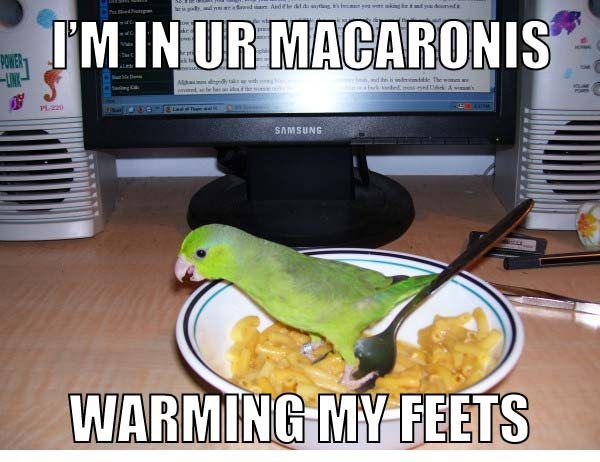
Back to the fun! Lately, there's been a phenomenon of putting funny text over a picture, frequently that of a cat; misspellings are very nearly mandatory. These are called image macros and they seem to be everywhere. The website I Can Has Cheezburger, a continuously updated blog of lolcats and image macros again, according to our friend, Wikipedia is: one of the most popular lolcat sites on the internet, receiving as many as 1,500,000 hits per day. And someone, or rather thousands upon thousands of someones are out there, continuously contributing lulz and attempts at lulz at breakneck speeds. But why is this crap funny? Perhaps the internet really is the great equalizer, making all of us equally stupid in the attempt to outclever each other and usually failing.


Not actually a lolcat.

And finally, this video attempts to explain memes and lulz; an exemplary montage of some of the stupid shit that people are putting on the internet. Warning: may contain offensive material.


Post script: I am such a nerd that what little actual HTML exists in this post was coded by hand.

Forget Taco Bell... Yo Quiero Justicia

Guess what time it is...
It's cliché time!

We live in America! The UNITED STATES OF AMERICA. We're free! We can pursue happyness happiness! With enough hard work and perseverance, anyone can achieve just about anything they put their minds to and be rewarded for their efforts!!! [IN THEORY.]

"Give me your tired, your poor, your huddled masses yearning to breathe free... [so that they may work repetitive menial jobs, for no money, no respect, and be subject to discrimination and alienation.]"


As discussed in the Gitlin article, there is a sense that the media marginalizes human beings as secondary to the objects that they own. The car is personified and replaces the idea of the human with a mechanical object that, in reality, does not have emotions nor a practical function. I see the same linear thinking when looking at images of immigrants and minorities in the media. Personally, as a San Diego native and the daughter of a Mexican immigrant, I have seen the dichotomy of American culture. America promises sidewalks paved in gold and a world of opportunity. It isn't until they've arrived, that they realize that this is farce; America promises back-breaking labor at $5.25 (or less) an hour and a loss of identity. And yet this is far better than what they are promised in their own distinctly poor homelands.

Growing up in a border town, I was given context for the immigrants' plight. Each day hordes of people run to the border to secure a better life for themselves and their families. American media trivializes this idea of "running to the border" by marketing TACO BELL in the same way-- Make a run for the Border. Think about it-- you can go buy cheap, fakey Mexican food at all hours of the night from the same people who actually did make a run for the border. Ironically, they probably never fathomed that they'd be working in a place where they're ice cream scooping refried beans and squeezing tubes of sour cream into cardboard taco shells. Cross the border and you'll find out that the alternative to selling Taco Bell tacos and living in tiny shoebox-sized apartments is pimping out your six-year-old child to sell Chicklets and living in tiny shoebox-sized huts made of flattened tomato cans and cardboard. Sons and daughters are sent to the U.S. to make enough money to eventually bring the entire family and save them from the numbing poverty that plagues Latin America.

Latinos, particularly "illegal immigrants," are marginalized into one huge collective group, stripping the individual of their own identity and applies a truckload of stereotypes in order to keep hierarchy alive in American culture. Marx would agree that the working class, those working the menial jobs, will prevail, feeding on the "goodness" that can be, theoretically, found in every person (cough-employer-cough). Here's the catch-- the employer isn't looking at his Latin employee as an individual with a family to feed and rent to be paid; rather he's looking at this faceless droid as cheap labor. The Latin individual is blank, devoid of identity-- of self worth. Rather, Latin Americans must resolve to be a part of this network of stereotypes that the media tends to proliferate.


In my search for clips of Latinos in the Media, I've found evidence that Latinos are nothing more than nondescript, chihuahua-loving, taco-eating, slow, dirty, border jumping, party-loving, egotastical, menial workers. Isn't there more to this group of people than what the media paints them as? Yes. Does the average American care to dig further than what they've seen? No. That's the problem, we're not making the effort to defuse these predetermined ideas.

In short, we live in a land based on the exploitation of non-citizens.

A Spoon Full of Media Helps the Hegemony Go Down…in the most delightful way*

Theodore Adorno was interested in people taking media into their own hands, countering the effects of established, corporate capitalism and re-educating the public through the very engine that feeds the status quo, the mass media. In large part, the rationale behind why right-wing America has resisted acknowledging global warming is that in doing so, they would have to agree that the energy industry has to also change, and that would lead to a loss in profitability. Giant corporations such as the auto industry (closely linked to the energy industry) have also not embraced energy-efficient cars because it would require tremendous capital investment on their part to re-tool their companies. They would suffer a severe loss of profitability (in the short run) for an industry that is already vulnerable, having already lost a large part of its market share to foreign auto makers. No one in corporate America wants (or has any incentive) to spend the capital necessary to retool in order to “save the polar bears from global warming,” so they will attempt to hold off as long as possible. There is still plenty of money to be made without conceding to the demands of the masses or scientific evidence of climate change. NASA is an arm of the government that, with other government agencies, routinely uses the mass media to quell people’s discomfort by suggesting that there really isn’t a problem, at least not one worth worrying about. The media tend to go along with this “false conflict,” without examining its validity. When possible it is better for established institutions to appear ready and able to resolve conflicts and solve problems, particularly ones that are of little concern. This is an example of the tacit collusion between the mass media and the government to never question its authority or expertise unless it is unavoidable.

"The power of the culture industry’s ideology is such that conformity has replaced consciousness. While it claims to lead the perplexed, it deludes them with false conflicts which they are to exchange for their own. It solves conflicts for them only in appearance, in a way that they can hardly be solved in their real lives" (Adorno, 1991).


The motivation of mainstream media can never be delinked from corporate advertising since that is what pays for their programming. It is these corporations that are the clients of mass media, not the public.

The “We campaign” represents a form of new media whose client is the public. This group is making a concerted effort to undermine the corporate media monopoly.


In these clips, we see, we hear a message about global warming—that we are in crisis; that we need to solve it together, and we need to do it now as a united force of many rather than a unilateral effort of a few. Stop drawing arbitrary lines in the sand that divide and thwart the process of this endeavor to save our planet—we all live here—act now! Freedom from dependence on fossil fuels is within our sights—demand it! Take it into your own hands, make a difference and do it along side your adversary.

"Although the culture industry undeniably speculates on the conscious and unconscious state of the millions towards which it is directed, the masses are not primary…the customer is not king, as the culture industry would have us believe, not its subject but its object" (Adorno, 1991)


I believe that Adorno would applaud these attempts, but he also might criticize it since it is merely the bourgeoisie competing with the ruling class and not really empowering the people. In fact, the We campaign might be a wolf in sheep’s clothing, since these new media are trying to influence the masses in much the same way as the ruling class, because they have the means to do it. The We campaign is using the media in an attempt to reform the ruling class, undermine the rigidity and oppressiveness of the status quo, but without realizing that there is another class to which they are not speaking—the unmentioned class—the working class or the lower class—commonly referred to as the “working families” families of America. This particular campaign does not speak for these people. The We campaign speaks for the liberal segment of the bourgeoisie. They are clearly not class conscious in the Marxist sense, and they do not see that there is something missing from their campaign. They believe in what they are doing because they know that there mission is to save the planet. The bourgeoisie is not the ruling class. The bourgeoisie is the class that performs the entrepreneurial and administrative work required by the ruling class to rule. The people aligned with the We campaign have the economic and political freedom to pursue their activism—the kind or work you don’t need to get paid for. What about the masses of working families? They still don’t have a voice. “We” is a good movement, a liberal reform, but Adorno, like Gramsci, would probably say that it’s not nearly enough.


"The total effect of the culture industry is one of anti-enlightenment, in which, as Horkheimer and I have noted, enlightenment, that is the progressive technical domination of nature, becomes mass deception and is turned into a means for fettering consciousness" (Adorno, 1991)


Where is the radical media re-organization!?


*A Spoonful of sugar helps the medicine go down

The medicine go down

The medicine go down

Just a spoonful of sugar helps the medicine go down

In a most delightful way

(Walt Disney’s Mary Poppins)

Friday, September 26, 2008

She's crafty, and she's just my type

Turn on the Food Network any weekday between 4 pm and 7 pm. Here's what you're likely to see: women preparing meals in a home kitchen. Five women each host a show in the hours in which (presumably) viewers are at home and thinking about what's for dinner that night. By the looks of it, you'd think every woman in America cooks dinner every night. . . or is supposed to. What exactly are we looking at and integrating into our beliefs when we watch these cooking shows?

I have a few guesses.

Let's meet our cast of characters. First up is Sandra Lee. Semi Homemade with Sandra Lee is all about taking shortcuts; for each recipe she combines 70% ready-made products with the other 30% of the ingredients prepared by hand. The best part about her show is that she ends every episode with booze.

Next is Giada di Laurentis. In her show, Everyday Italian, di Laurentis cooks (what else?) Italian food. She has a lot of male fans.

Fancy foods (with French names) are Ina Garten's forte. Barefoot Contessa is set the Hamptons, where Garten entertains in her picture-perfect farmhouse kitchen. She likes to make labor-intensive recipes with expensive ingredients.

Paula Deen dishes out generous helpings of Southern comfort food in her programs. Paula is infamous for starting every recipe with a stick of butter and for making funny faces when she tastes her dishes.

The afternoon cooking block ends with an hour of Rachael Ray's 30 Minute Meals. Ray has been a fixture on Food Network for over a decade. And despite her inordinate perkiness and unique phraseology (she coined such terms as EVOO for extra virgin olive oil); her popularity only increases.

So what are the prevailing trends among these shows? The most obvious, of course, are issues of gender and space -- or gendered space. All of these programs tell a story from the same point of view: the home kitchen is the place in which women must cook. According to these shows, womanliness and domesticity are inextricable. And for whom do the cook? Their husbands; all the women are married (except Lee, a divorcee since 2007, who allegedly has been dating the same man since the divorce). Preparing food may be viewed as an act of subservience to men.

Another strong undercurrent in the shows is linking food with desire and sensuality. Watching shows like this will whet one appetite or another. That connection is easy to make just by looking at how the women dress; it's pretty clear that this is eye candy for admirers of the decolletage. But I believe that there are subtler forms of desire that the shows address as well.

These women seemingly "have it all": a beautiful home, a family, a successful career, and enough time each night to make a fabulous dinner to boot. It's as if they provide a model for female viewers to emulate. Is this the way of life that the viewer (male or female) is supposed to desire?

And what did you think of their posh kitchens? Clearly these ladies are living the good life. . . maybe even the American Dream. All of the kitchens evoke a sense of wealth, which is sometimes combined with a WASPy sensibility (as is the case with Sandra Lee). The back stories on Lee and Paula Deen are very rags to riches; they both were the sole providers for their families of young children and came into their fortunes by ingenuity. Similarly, Rachael Ray came into her profession by a lot of hard work and more than a bit of dumb luck; she never trained as a chef. Their shows give the audience a hope of upward mobility, and reiterate the promise of the American Dream.

Just keep watching the Food Network and sooner or later you'll find something (or rather, someone) to suit your tastes.

Look at me-- I've watched Rachael Ray so much that my initial annoyance with her quirks has evolved into full blown idolatry. Not only do I watch and enjoy her daytime show every chance I get, but I also want her to be my BFF.

Hmm, looks like I'm complicit in my subjugation.

Thursday, September 25, 2008

Beautiful aging of the masses: A proposal for appreciating what everybody will be.

It is (intuitively in the Gitlin sense) a fact that the elderly members of our society are treated with less than optimal respect. In the vein of intuitive discovery that Gitlin has used in his post on pop culture which we have read for this class I assert that it is easy to convince people that the elderly deserve to be appreciated more than they are. (This insert is a little long but you might just let the music play while you read on as the tone of the tune/soundrack has an aesthetic element which lends itself to the sentiment of what I am asserting. Otherwise forty seconds will inform you.)

However, there are people in society who know this as a result of their experiences.


Among this population are these young medical professionals who (presumably) care for the elderly. The way in which they have taken control of "the means of production" as per Marx is an indication of the true humanistic nature of some members of our society. They wish to do good. They have done good by attempting to understand through "ethnographic" analysis what it is like to be old.

In the Gramscian sense perhaps one could criticize this exercise as a useless crumb thrown to the agressive train of humanity which will never accept our geriatrics as fully human. But in the Gramscian sense there is also (I would assert) potential here for the use of the means of production to become more than a crumb. That is not to take away from the positivity that created this media looking at the elderly. Marx would congratulate the producers of this kind of media:


In the Marxist sense this is a departure from the control of media by conglomerates.

In my opinion, it is the first step. This media needs to be seen to be appreciated. I believe, in the Gitlin sense, intuitively that I would have a challenge ahead of me to find one who would disagree with the sentiment that our elderly deserve better/more.

Therefore, this kind of media needs to be shown in schools and spread out through the virtual (and therefore real) world. We need to get this message to the forefront of people's thinking. People want to help and love our elderly. They just need to be shown how. This media can do that - people do want to help:


Media have a certain amount of power to influence. Surely it can be a force for the realization of the attributes of our elderly. But these media need to be seen. Now that we have the means of production distributed among the masses, how do we get the masses to see the production?

This may seem simplistic but if each of us brings this blog to the attention of our mother/father/grandmother/grandfather/aunt/uncle/etc. - then more people will be aware that they are not alone in their thoughts about the elderly in our society, whether they are elderly or not.

Now, that is progress.